The Pros and Cons of Social Media Background Checks

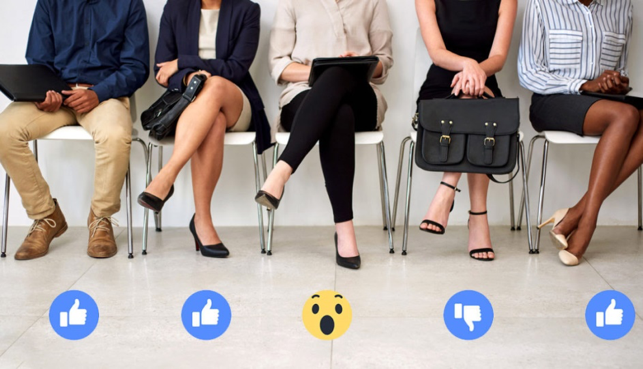
You are in the process of interviewing candidates for a position and you have narrowed it down to your top 3. Typically you conduct background checks by calling references and verifying previous employment. But in today’s world where everything revolves around social media, it’s no surprise that Human Resources departments are turning to social media platforms to check their candidates’ backgrounds before making any hiring decisions.

Let’s take a look at the Pros and Cons of conducting social media background checks:

Advantages

1. Easy Background Check

Social media screening is a cheap way for a background check, the employer can access them anywhere they are and can make an immediate decision of hiring the candidate. It saves a lot of time to learn about the candidate through Facebook and LinkedIn profiles and does not require any additional money to be spent. Facebook posts are an easy insight into the candidate’s day to day life; Twitter is good to learn about how opinionated they are or about their personal thoughts. On the other hand, LinkedIn is good to learn about their professional makeup. With so many aspects available on the web, it is easy to know about the candidate in a complete way.

2. Eliminating Discrepancies

Social media background checks are a good way to confirm information on a candidate’s resume. Social media sites often provide information on the user’s previous occupations and work history. You can compare to see if there are any discrepancies in the resume they submit for the open position. A candidate may also claim to be an expert in a specific subject matter or have participated in certain volunteering efforts. Most of this information can be confirmed online on their social media platforms.

3. You Learn Who Your Candidate Really Is

Why do people tend to be more open and vulnerable on social media? Whether on Facebook, Instagram, or Twitter, users often let their guard down and are completely honest. Whatever the reason, this can prove to be beneficial to HR because few candidates feel free to truly be themselves in such a formal and high-pressure environment. During the job interview the candidate tends to put up the best foot in every aspect, hence, it does not provide the complete picture as to how a candidate will behave on a day to day basis at work.

But looking at online profiles can tell you what someone is passionate about or how they treat other people. It can also help you spot red flags. Does your candidate have a habit of ranting about her boss and colleagues online? Does an applicant who seemed friendly in the interview crack racist or sexist jokes on Twitter?

The information revealed by a social media background check is rarely essential to the hiring process, but in some cases, it can help you spot major red flags about a person’s character. Respect for others is always the main agenda for an employer that they look in a candidate and this information can easily be found in social media space. Someone who badmouths a company or spouts off derogatory remarks online is not a good ambassador for your brand and is probably someone you want to pass over when you are hiring.


Disadvantages

  1. Legal Risks

While your social media background screening may seem innocent and purely professional, you could be exposed to potential legal risks in terms of privacy and human rights should your background screening methods be used against you. The legal risks may arise from the public information you gathered about the candidate.

For example, a candidate might list his age, race, religion, or sexual orientation as part of a Facebook profile. Whether you want to admit it or not, subconsciously learning this information about an applicant may affect how you feel about them. Hiring managers are at full liberty to have their own opinions about sensitive political, religious, and lifestyle matters, however, the second those opinions influence a hiring decision, they become discrimination.

  1. Privacy Settings

Most social media sites allow users to adjust the privacy settings on their profiles. Smart candidates are more careful with what they post online. With this knowledge, candidates can easily create a social media profile that works to their advantage and HR has no choice but to accept what can be seen publicly as the truth. Be mindful that what you see is not always what you get.

  1. You Might End Up Wasting Time

One of the biggest problems with social media background checks is that it’s unpredictable. Finding people on Facebook, Twitter, or LinkedIn can be a challenge if you don’t share any connections or mutual friends. And even if you do find your candidate, privacy settings on social platforms can make it impossible to view their posts. Social media background checks can end up being a lot of work for potentially no return.

Conclusion

If you’re thinking about browsing the social media profiles of your top candidates, you need to consider both arguments before deciding.

Always run other types of background checks regardless of your position on social media background checks. Social media can tell you more about a person – from general likes and dislikes to character details – but it can’t replace traditional and trusted background check sources such as criminal screenings and employment verification checks.

If you ever decide to use a candidate’s social media profile for hiring purposes – whether to find contact information or to run a full-blown social media background examination – have someone other than the hiring manager do the work. Looking at a Facebook page can unintentionally reveal too much information – as such, it’s a good idea to have a person uninvolved with the hiring manager look through the applicant’s social accounts and prepare a report of relevant or potentially relevant information. This person can act as a filter, keeping information that might create a bias out of the hands of the hiring manager.


About Us:

We have been mining social media since 2007 for our clients. By utilizing best in class software programs, we offer a service called eChatter.

eChatter works with you to obtain your objectives in a fast, accurate and reliable facet. By keeping our strengthened principals, yet evolving with this industry, we lead in social media monitoring. Since 2007, we have been dedicated to providing our customers with the most authentic data.


We offer:

·       Deep Web Scans

·       Jury Vetting

·       Jury Monitoring

·       Quick Scan


www.e-chatter.net

(866) 703-8238


#ThinkBeforeYouPost: FBI Warning

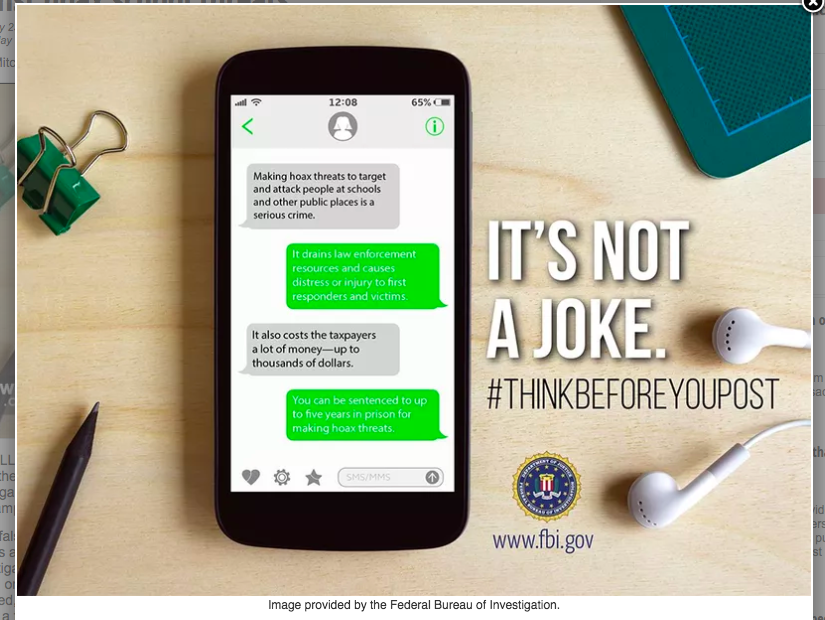
As more and more false alarms are popping up regarding school shootings and bomb threats, the FBI gets proactive in its defense of such action. Anyone thinking of pulling one of these hoaxes ought to think twice before doing so.

Wednesday, May 30, 2018, the FBI began a proactive social media campaign titled, #thinkbeforeyoupost. The statement the FBI issues includes:

“Making false threats drains law enforcement resources and cost taxpayers a lot of money,” a news release from the FBI states. “When an investigation concludes there was a false or hoax threat made to a school, or another public place, a federal charge could be considered, which carries a maximum sentence of five years in prison. If a federal charge is not warranted, state charges can be considered.”

Using law enforcement officers to handle hoax threats takes them away from solving real crimes and is also a drain on the city’s budget.


social media investigations


If anyone is aware of any potential threats or suspicious activity, they are asked to call local authorities at 911, or contact the FBI via tips.fbi.gov or over the phone (1-800-CALL-FBI). The public can also call their nearest FBI field office or report a tip.

Equally important is Homeland Securities “If You See Something, Say Something®” campaign. Reporting suspicious activity in social media is very important. Be sure to contact your local law enforcement agency with details; such as who or what you saw, when you saw it, why you feel it is suspicious and where it occurred.

Social Media Helps Solve Cases

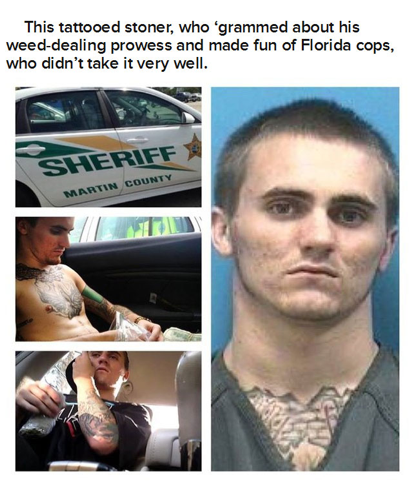
Do criminals want social media likes so badly that they will incriminate themselves? Apparently so.

Last week a cocaine dealer’s student girlfriend helped police bust a major drug ring by bragging about her luxury lifestyle on Instagram. Emily Lock, 22, of Llanbradach, Caerphilly, earned less than $10,000 as a checkout worker at Lidl, but openly flashed designer clothes, shoes and extravagant holidays. Along with her dealer boyfriend Mark Price, 27, they spent over $100,000 on foreign travel and high end goods. So that has authorities wondering where did they get that kind of cash? Drugs maybe?

Lock and Price, who claimed to be a struggling builder, repeatedly purchased Vivienne Westwood handbags, Gucci sunglasses, Christian Louboutin shoes and Christian Dior perfume. She ended up being jailed for 15 months and landed her boyfriend behind bars for seven years.


Check out these other not-so-bright crooks who incriminated themselves with their posts.

1) Conor Murphy, 19, posted a picture of himself on Facebook eating a ‘Cash Sandwich’. The pictures would eventually lead police to connect him to an eight-man gang who stole a fleet of expensive, high-performance cars from some of London’s wealthiest residents. They stole BMWs, Range Rovers, Porsches and a $100,000 Mercedes – as well as jewelry, phones and laptops in 15 separate burglaries. Detectives finally caught them after one of the gang members posted a picture of himself on Facebook sitting on the hood of a stolen black Range Rover.

2) Leon Roberts, 38, and Jade Muzoka, 27, claimed damages after their weeks’ vacation in Turkey. The couple alleged they both suffered from food poisoning and tried to collect around $3,000 compensation. But just days after returning home the bodybuilders uploaded 79 photos on social media bragging about their trip, including pictures of them guzzling drinks and dining on steak, lobster and sushi.

In a doctor’s note they claimed to have been bedridden with vomiting and diarrhea, but their pictures proved otherwise. Luckily, the images they posted saved the resort from having to pay over $2,500 in alleged damages. They were busted and given a 26-week jail sentence and ordered to serve 200 hours community service.


social media crime

3) Drug dealer Junior Francis, 33, boasted about his extravagant lifestyle on social media before being caught with $7,000 cash and $75,000 worth of crack cocaine and heroin during a home raid. Francis posted pictures online of him posing with wads of cash pressed like a telephone to the side of his face. In an Instagram post he quoted rapper Notorious BIG, writing ‘everything I got I work hard for it’ under a picture showing thousands of pounds in cash on a kitchen top. Smart, right?

He initially denied any involvement in drug dealing during an interview after the home raid but when police checked his mobile phone, they found evidence of transactions with street level dealers in south London. Francis was jailed for six years and eight months after admitting possession with intent to supply Class A drugs and money laundering.


4) The mysterious murder case of a Canadian girl was solved after police found clues in the Facebook selfie posted by her friend. Brittney Gargol, 18, was found dead near a landfill in March 2015 and an autopsy later revealed that she died of strangulation. Gargol’s friend Cheyenne Antoine, 21, plead guilty to manslaughter after they found a Facebook selfie showing her wearing the belt used to strangle her friend. The wide blue woven belt with a large buckle was found on a roadside next to Gargol’s body, and Antoine was seen wearing the same belt in a photo posted to her Facebook account just hours before the killing, according to the Saskatoon Star Phoenix.

Investigators got suspicious of Antoine when she initially told them about spending time with the victim the night she died, but left her friend to visit her uncle. That statement was later proven false. Antoine then told investigators that she and Gargol partied with two men, who allegedly strangled the victim and put a gun to her head to help them. The second statement was also proven false.

“It’s quite remarkable how the police developed this information,” prosecutor Robin Ritter said in court adding that Antoine poses a threat to public safety. She “has issues … and because of those issues, she is dangerous.” At her court appearance Monday, Antoine’s lawyer, Lisa Watson, said her client suffered through sexual, emotional and physical abuse as she grew up in foster care. “My client had some very deep-seeded personal issues that she was not dealing with and unfortunately, for whatever reason, we’ll never know, they turned into a very tragic situation for all involved,” Watson said.


Workplace Harassment and Social Media

For decades, instances of sexual harassment have been brushed under the rug and business have only reacted when it’s “really bad” or “high profile.” But a staggering 1 in 5 Americans reports being sexually harassed at work and 75% of those who report their abuser experienced retaliation for speaking up.

Thanks to social media and the #MeToo movement, as well as the general movement to become better human beings, sexual harassment is no longer being tolerated.

So what can business owners and human resources managers do to make work a better place?

  • The first step is for business owners to educate themselves about sexual harassment, including the basics of harassment, discrimination, retaliation and workplace bullying. All managers should know their responsibilities and liability, as well as their duty to prevent harassment and abuse. It’s up to owners to lead the way in the workplace’s professional and respectful behavior. You should know how to receive and respond to a complaint and be familiar with confidentiality guidelines and the rights of all people involved.
  • Business owners must implement workplace strategies to prevent occurrences of harassment. Establish boundaries and policies regarding harassment and make sure all new and existing employees are trained in those areas and are taught how to file a complaint.
  • Business owners must enforce the company’s policies and practices. Offenders must be disciplined according to the severity of their behavior. Penalties could include one-on-one sensitivity training, suspension with or without pay, or possible termination. When policies and procedures are enforced, it demonstrates a no tolerance stance to employees and will further discourage workplace harassment.


workplace sexual harassment

  • Don’t ignore your employees when they say they’re being harassed. It can be isolating, humiliating, and stressful for an employee to come forward about an abuser, particularly if that person has corporate power over them or is well-liked by peers.
  • Last, look for indicators of abusive behavior before hiring. You’re probably asking yourself how can you possibly spot a harasser before hiring them? Check social media! This is a far better method than standard or criminal background checks used widely in business today. Social media screening can identify potential harassers by flagging material that willingly and publicly disparages women or minorities online, or that blatantly promotes sex or violence.
  • Sexual harassment is a complex issue and as difficult as it may be, the effort to prevent workplace harassment matters. Aside from the distress caused by workplace harassment, discrimination and retaliation, the behavior is illegal. Anyone that commits these acts is a tremendous liability. Addressing harassment proactively instead of reactively avoids personal, business and legal problems.

It’s also important to provide resources for anyone experiencing abuse, and make sure your HR team knows what to do when harassment is reported. If an employee does not feel safe reporting the problem, they probably won’t, and this means the problem will only grow as an attacker feels trapped by silence. That spells disaster for employee morale as well as for your business’s reputation if you’re caught with a harassment scandal you did nothing to prevent.

Social Media’s Role in Finding the Missing

Every three minutes a child is reported missing in the UK; across the EU that number rises to one child every two minutes.
In the US, the FBI recorded almost 467,000 missing children in 2014, which is close to one reported every minute
.

In the US, milk cartons, posters, flyers, and traditional news reports were the main missing child search channels until 1996, when Dallas-Fort Worth broadcasters teamed up with local police to develop a warning system that interrupted regular programming on television, radio broadcasts and highway signs. That service, Amber Alert, is used only for the most serious of cases, sending out messages via email, text, traffic signs and digital billboards, as well as through Twitter and Facebook.

In 2015, Child Rescue Alert partnered with Facebook to harness the social network’s reach. Now, when a missing child case meets certain criteria of seriousness, law enforcement agencies can issue geo-targeted posts, containing a photo and description, to appear in the newsfeeds of Facebook users in the area where the child is believed to be.

Rachael Powers, a criminologist at the University of South Florida, says that social media has become “the new milk carton campaign” for police departments across the country, stressing the importance of publicity for missing persons cases. “It’s the difference between 40 eyes and 4,000 eyes,” she says.

“Time is often a crucial element when locating vulnerable missing people who are at risk to themselves or to the public,” says Metropolitan Police commander Alison Newcomb. “The use of social media supports our investigations and appeals and has achieved great results, some of which simply could not have happened through traditional communication channels.”

DC cops are also doing more to publicize the most critical cases. In December, the department began issuing press releases for every single “critical missing” person—defined as anyone under 15, over 65, or otherwise deemed to be vulnerable. Not every critical case had received a press release under the old system. This year, DC officials said at the press conference, 95% of the missing persons cases have been closed.

“If a person goes missing, commands make initial notifications on social media. Then posters are made,” said Zachary Tumin, deputy commissioner for strategic initiatives and leader of the NYPD’s social media efforts. “As that information gets retweeted by police and the public, word spreads very quickly to be on the lookout for that missing person.”

“First year results aren’t in yet, but I think we’ve been successful. We currently have hundreds of thousands of followers on Twitter and we have to take advantage of that going forward,” he said. The NYPD’s Twitter campaign comes three years after the creation of its Facebook page, which currently has more than 380,000 likes. Tumin expects all police officers to be issued their own smartphones in the next year or two; that will help them push out information quickly.

Before social media, spreading the word about the missing was hampered by limited outreach to those in direct position to help. Amber Alerts were mainly broadcasted on television, radio and on highways. Distribution of missing posters was also limited, only displayed in communities in which the individual was last seen and or lived.
Now, organizations like National Center for Missing & Exploited Children can increase the likelihood missing children are found thanks to more immediate and full-range awareness raised on Facebook, Twitter and Instagram. These social media platforms have 1.2 billion, 288 million and 300 million monthly active users, respectively.


missing kids and social media

“Our social media properties allow us the ability to geo-target our missing children’s posters. In doing so, we are able to reach people who may be in a direct position to help,” said Ashley Iodice, spokesperson for the National Center. In March, the non-profit ramped up video production across all its social media platforms and launched videos that feature family members of lost children. “We have found that video elements in the digital media space garner more viewership, which we believe will help in finding more missing children,” said Iodice.

Gavin Portnoy, head of digital media at the National Center for Missing & Exploited Children, which makes active use of Facebook, Twitter, YouTube, Instagram and Snapchat, has proof of the power of sharing. In 2015 the charity created a video appeal featuring imagery of a missing girl and the person they suspected had kidnapped her. The video was shared widely and a woman spotted them. “People feel empowered to make a difference; it’s the opportunity to do something,” he says. Portnoy, however, says that while he recognizes that social media is by no means a perfect tool, its benefits should be acknowledged. “It is another really positive tool that’s in the arsenal of the public, of law enforcement, of non-profits like us that are trying to help.”


About Us:

We will conduct a missing child social

media search for FREE anytime! 

We have been mining social media since 2007 for our clients. By utilizing best in class software programs, we offer a service called eChatter.

eChatter works with you to obtain your objectives in a fast, accurate and reliable facet. By keeping our strengthened principals, yet evolving with this industry, we lead in social media monitoring. Since 2007, we have been dedicated to providing our customers with the most authentic data.


We offer:

·       Deep Web Scans

·       Jury Vetting

·       Jury Monitoring

·       Quick Scan


www.e-chatter.net

(866) 703-8238