Best Practices for Cross-Referencing Data Points in an OSINT/SOCMINT Investigation

Why Cross-Referencing Matters

In the world of Open-Source Intelligence (OSINT) and Social Media Intelligence (SOCMINT), collecting information is only the first step. The real value comes from validating that information through multiple independent sources. A single data point can be misleading, outdated, or intentionally deceptive. However, when several unrelated sources independently confirm the same information, investigators can have much greater confidence in their findings.

Professional investigators understand that successful investigations are built on corroborated evidence—not assumptions.

What is Cross-Referencing?

Cross-referencing is the process of comparing information obtained from multiple sources to determine its accuracy, reliability, and relevance.

For example, a subject’s LinkedIn profile may list a current employer. Rather than accepting this information at face value, an investigator should compare it with:

  • State business records
  • Professional licensing databases
  • Public court filings
  • News articles
  • Company websites
  • Social media activity
  • Archived web pages
  • Property records

Each source either strengthens or weakens the credibility of the information.

Best Practices for Cross-Referencing Data

1. Define Your Investigative Objective

Before collecting information, determine exactly what you are trying to prove or disprove.

Examples include:

  • Verifying employment
  • Confirming a current residence
  • Identifying associates
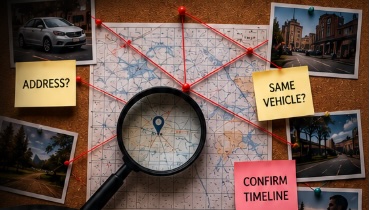
  • Establishing a timeline
  • Locating hidden business interests
  • Confirming travel or locations

A clear objective prevents information overload and keeps the investigation focused.


2. Never Rely on a Single Source

One source rarely tells the complete story.

Instead, compare information across several independent sources.

Good examples include:

InformationCross Reference With
Social media postEXIF data, Google Maps, weather history
Business ownershipSecretary of State records, LinkedIn, company websites
VehicleDMV records (where available), photos, insurance claims
Phone numberPeople search databases, messaging apps, breach data
Email addressSocial media, breach databases, domain registrations

The more independent confirmations you obtain, the stronger your conclusions become.


3. Verify the Source Before Trusting the Information

Not every source deserves equal weight.

Evaluate:

  • Who published it?
  • When was it published?
  • Has it been independently verified?
  • Could the information be outdated?
  • Is there evidence of bias?

Government records generally carry more weight than anonymous forum posts.


4. Build a Timeline

One of the most valuable investigative techniques is organizing events chronologically.

Create a timeline showing:

  • Employment history
  • Address changes
  • Social media activity
  • Court filings
  • Business registrations
  • Vehicle purchases
  • Property transactions

Timelines often expose inconsistencies that individual records never reveal.


5. Compare Different Types of Data

One of the strengths of OSINT is combining multiple forms of intelligence.

Examples include:

  • Photos
  • Videos
  • Metadata
  • Maps
  • Public records
  • Social media interactions
  • Archived websites
  • News articles
  • Court documents

Each piece of information provides context for the others.


6. Look for Corroboration, Not Confirmation

Confirmation bias is one of the greatest risks in investigations.

Rather than looking for information that supports your theory, actively search for information that disproves it.

Professional investigators ask:

  • What evidence contradicts this?
  • Could there be another explanation?
  • Is there a better source?

Objectivity leads to stronger intelligence.


7. Document Every Source

Every finding should include:

  • Source name
  • URL or document reference
  • Date accessed
  • Screenshot or archived copy (when appropriate)
  • Notes explaining why it supports the conclusion

Proper documentation ensures your findings are defensible if questioned later.


Example of Effective Cross-Referencing

Imagine a subject claims to live in Dallas, Texas.

Rather than accepting this claim, an investigator might compare:

  • Facebook check-ins
  • Instagram photos
  • LinkedIn employment
  • Property ownership records
  • Secretary of State filings
  • Google Street View imagery
  • Court records
  • Business licenses
  • Professional licenses
  • News mentions

Conclusions

Cross-referencing is one of the most valuable skills an OSINT or SOCMINT investigator can develop. While collecting information is relatively easy, validating that information through multiple independent sources is what transforms raw data into reliable intelligence.

By following a structured process—defining objectives, verifying sources, building timelines, documenting findings, and corroborating evidence—you can produce investigations that are accurate, defensible, and actionable.

At eChatter, our investigators use these best practices every day to support legal professionals, insurance companies, corporations, and private investigators with reliable, evidence-based intelligence.


From Posts to Paychecks: The Influence of Social Media in the Workplace

In today’s hyperconnected world, social media applications have become the go-to space for people to share their thoughts, feelings, opinions and experiences. While social media has endless benefits, such as staying connected with friends, family and the world at large, the boundaries between personal and professional life have never been blurrier. It is well known to some, but sadly not all, that what you share on social media can have a profound impact on your career and personal reputation. It’s a double-edged sword, a powerful tool for self-expression and networking, but one that can also be a slippery slope, potentially costing you your job and damaging your reputation in the blink of an eye. There are many ways, within the intricate web of social media, you can experience real-world consequences of the content you choose to share. 

Current Events

First of all it has to be taken into account that the world is currently under a considerable amount of stress. Natural disasters have resulted in loss of lives, widespread destruction, and escalated tensions among nations and individuals. At this very moment, we are watching an unfolding conflict between Israel and Hamas, prompting people from all around the globe to express their thoughts, feelings, emotions, and political stances on social media regarding this complex issue. This war has ignited powerful sentiments worldwide, with many taking sides in this particular conflict. 

The Associated Press (AP) recently found themselves in a predicament when one of their reporters, stationed in Gaza, was discovered to have a long history of publicly condemning Israel as an oppressive, apartheid regime. This raised concerns about the reporter’s ability to provide objective coverage of this conflict. A deep examination of the reporter’s X profile (Twitter) uncovered multiple tweets dating back to 2019, reinforcing the perceptions that his views on Israel were deeply rooted. 

As a result, AP has taken the steps of relieving the reporter from his duties and is actively investigating his social media history. Interestingly enough, this is not the first time such an incident has occurred at AP. In 2021, the organization hired and subsequently fired a Stanford graduate who had previously posted anti-Israel content on social media. The question is, did either of these employees ever wonder if what they shared on their social media would be reviewed by their employer? 

Social Media and the Hiring Process

Recent data from The Harris Poll revealed that a significant 71% of hiring decision makers concur on the effectiveness of scrutinizing candidates’ social media profiles as a screening tool. This statistic underscores a proud shift in the way our society approaches hiring practices. Social media’s influence has grown to such an extent that your resume is no longer the sole focus during the application process. 

DeeAnn Sims-Knight, the visionary founder of Dark Horse PR, aptly captures this evolving landscape: “Because we tend to view our personal social media accounts as being “personal”,  there’s a good chance that by viewing someone’s profile, you’ll get a glimpse into their personality beyond their resume.”

In this digital age, where our online presence can be as impactful as our real-world identity, it has become increasingly vital for job seekers and professionals alike to carefully curate their digital footprint. Your online presence isn’t just an extension of your resume; it’s an essential part of your professional identity. 

Social Media and the Workplace

Over the course of our seven years in business at E-CHATTER, we have seen first hand human behavior through social media and the role it plays in the workplace. According to Zippia, 98% of workers have social media for their own personal use. Alongside that statistic, 77% of workers report using and engaging with social media at work. It is not uncommon for employees to exhibit patterns and tendencies when sharing content online throughout their day. Many individuals are drawn to sharing an abundance of personal information. According to Harry Denley, a hacker and Security and Anti-Phishing at MyCrypo, said: “Most people are very verbose about what they share online. You can find virtually anything…” 

People Magazine shared some truly astonishing testimonies of individuals who either experienced firsthand or witnessed the repercussions of their online activities. One particularly shocking case involved a nurse who shared posts to her Facebook such as, “Soooooo sleepy here in the ICU. Will someone please code and give me something exciting to do? #isthatbad?” alongside racist comments. What made this even more astonishing was that the nurse had tagged her posts with the location of the hospital where she worked. 

Another example within the article showcased a co-worker who was dismissed from their job for indulging in marijuana and alcohol during work hours and proudly shared photos of these activities to social media. Unsurprisingly, their boss discovered the incriminating posts and promptly terminated the employee. 

One of the most ironic stories shared of them all was the tale of a firefighter who was let go from his position after leaving work multiple times for an “emergency”. He was later caught sharing images to social media of him swimming in a pool and riding quads posting, “sometimes you just need to F-off from work”. 

Social Media Oversharing

To comprehend this tendency, we must consider the unique dynamics of social media. Many perceive it as an outlet where they can shout into the void, assuming their posts will go unnoticed or that their identity will remain concealed. Sharing on social media offers a buffer period between the confession and the consequences, completely removing the power of face-to-face interactions. More than anything, most underlying reasons for oversharing on social media have to do with chasing clout or those “15 minutes of fame”. It can alleviate feelings of isolation, connecting individuals with like-minded people who empathize with their experiences. 

With these insights in mind, E-CHATTER approaches online investigations with the understanding that there is a high likelihood that someone, at some point, may have inadvertently shared crucial information. Let’s consider a few real-life stories that vividly illustrate the unforeseen consequences of thoughtless digital actions. 

Social Media History

While some individuals face termination in the workplace due to their current posts or comments, others may be terminated based on their social media history. Depending on the company’s policies, your social media past can hold as much significance as the posts made during your tenure. E-CHATTER has taken on cases that involved scrutinizing individuals due to discrepancies in their work history as listed on their resume. In one notable instance, an individual asserted that they had long-term employment with some of the most prestigious companies and organizations in their industry, a claim that didn’t stand up to analysis.

As our investigation unfolded it became evident that this individual was operating online under a different name. They were actively hosting a podcast that delved into their life, exposing a trail of admissions related to drug use and inappropriate content. This revelation proved to be a potential catastrophe averted for the employer, underscoring the importance of thorough background checks and the observance of a potential hire’s digital footprint.

In conclusion, the ever-expanding digital landscape has significantly altered the way we perceive and interact with the professional world. Employers must recognize the importance of closely monitoring their employees’ and potential hires’ online presence, especially in relation to sensitive topics such as race, sex, and discrimination. By proactively addressing and mitigating any harmful or inappropriate online content, businesses can not only safeguard their own reputation but also foster a more inclusive and respectful work environment. In today’s interconnected society, the boundary between one’s personal and professional life has become increasingly blurred, making it imperative for employers to adapt to these new realities and take a proactive stance in promoting a workplace culture that upholds respect, diversity, and equality for all.

Are Background Checks Failing Us?

All one has to do these days is turn on the local news to hear about another teacher, coach or employee being accused of a crime of either drugs or child sexual abuse. If you are like me, the first question you think of is, “Don’t they do background checks?” What we are starting to find out, is yes they do. The problem is with the way in which the background checks are being done and by whom.

Let’s start with the basics and the must haves. The FCRA, or the Fair Credit Reporting Act, was passed in 1970 to ensure regulations of the collection of credit information. Additionally, The Equal Employment Opportunity Commission   governs how this is to be done:

 In all cases, make sure that you’re treating everyone equally. It’s illegal to check the background of applicants and employees when that decision is based on a person’s race, national origin, color, sex, religion, disability, genetic information (including family medical history), or age (40 or older). For example, asking only people of a certain race about their financial histories or criminal records is evidence of discrimination.

Where the problem lies, in may cases, is with the actual agencies in which background companies receive their information. They may not be updated regularly enough. That in and of itself is a problem. But the list goes on…

background checks

You may be surprised to learn the following flaws:

  1. The FBI offers a National Criminal Information Center which is great, as long as the crime was reported to the FBI. Beginning in 1967, it is  dependent on records that have been provided by criminal justice agencies. It operates under a shared management concept between the FBI and federal, state, local and tribal criminal justice users.
  2. Many times education is not checked out thoroughly which can be very detrimental down the road. This includes professional licenses.
  3. They often don’t utilize the information from paid data bases.
  4. Social Media is rarely included. I don’t mean the prospective employee gives up passwords.  That should not ever be done in my opinion, however much can be gleaned by conducting a deep web investigation, without that information. A social media background check may reveal quite a lot about the character of the individual. Many HR execs are looking anyway, however hiring an agency is the safest way to go. A best practice is to never review your candidates’ social media profiles internally. This is beneficial because an agency’s review and social media report respect your candidate’s privacy and alleviates your employees from reviewing content that could lead to accusations of discrimination or violations of freedoms.