Reputation Management: Hire an Investigator

When you think of reputation management, what industry comes to mind? Perhaps you would think of a PR or Communication company. We have all seen commercials on TV around companies that can help you improve your image. They promise to get rid of those bad reviews, gather up good ones, and make you look like you are the best thing out there. But are they missing something? I believe they are. Here’s why.

Chief Reputation Officer

What many companies don’t think about is that reputation management is something that needs to happen proactively, not reactively. A recent Forbes article titled “Five Reasons Your Company Needs A Chief Reputation Officer” explained it best.

“Most companies, including your competitors, are usually only thinking deeply about reputation management after a crisis has hit. They react and try desperately to repair the damage. This is a huge missed opportunity because the damage done was often completely avoidable. Just like no sports team wins a game playing only defense, your company needs to play strong defense and come out with a strong offense.”

Forbes

Where the Private Investigator Comes In

When I speak to Private Investigators, I am amazed that many have not thought about this area as a vital way to grow their business. In my opinion, they should be considered to be part of any good reputation management program or team. In our digital world, they will be able to determine exactly what needs to be monitored and how. After all, they do this type of investigating all the time.

Family law, infidelity cases and divorce depositions have been mainstream avenues for revenue for decades. Some of the PI’s love them, and some avoid them like the plaque. Those that avoid them do so because of the amount of work vs. the amount of compensation.

Promote your business as a firm that covers Corporate Reputation Management services. By doing so, you are in some ways, investigating for a company in some of the same ways you would be investigating for a cheating spouse. Only better, because the work is proactive VS. reactive. If you catch an issue that a corporation has online before it goes viral, you have saved the day.

Back in June, we wrote about Employee fraud and COVID19. In that post, we cited a Fortune 500 company’s loss of over $100,000.00 because of a plant shut down due to a dishonest employee. It happens more than we know.

Proactive Steps to Take

As a service offering, it is smart to offer a corporate client a deep web scan on their business. What does their online profile reveal? Some things to consider:

  1. Reviews are obvious, but many people think of them as Yelp, Google, and Trip Advisor. They are the biggies, but there is much more out there.
online reviews

2. Location based Monitoring: Does the company have more than one location globally? By creating a virtual fence around physical locations, an added security level is created for any violent social media mentions in the area. Additionally, automatically pull in any negative keywords for reputation management.

3. Employee Revenge. As more and more employees are laid off because of our current pandemic situation, some are understanding and some are not. It is human nature. Just today, I read a post in LinkedIn about a disgruntled employee telling everyone how she was let go from a major company. She went on to say that she mistakenly placed all of “who she was” around this position for the past 8 years and how this was a major life mistake. Her post gained a lot of views and encouraging comments, as it should. However, think about the company’s name there. Most people are left with the impression that the company did something wrong to her. We don’t know the full story, but it can still leave a lasting impression. Glassdoor is a website where current and former employees anonymously review companies. I will bet many don’t even know about that one site alone.

See the possibilities yet? Do you think in today’s online world, this could be something your firm is capable of doing? Email me if you would like to kick around the idea for your firm.

Staying Ahead of the Social Media Curve

One area that OSINT & Social Media Researchers have in common with Social Media Marketers, is the challenge of staying ahead of the social media curve. It seems like almost weekly, social platforms change something. Most of the changes have to do with ease of use for the user or trying to adhere to changing policy regulations.

Facebook Classic VS New Facebook

Facebook recently changed the way your profile looks to a new version. They allow you the opportunity to toggle back and forth if you wish. The New Facebook update is also referred to as FB5. Facebook wants its platform to be centered around group and events more than in the past. It has a white background or you can choose a dark mode.

How does this affect our investigations? How is Facebook 2020 different from Facebook 2019? One area of interest is the emphasis on groups. We have discussed this in the past, but I think it deserves another look and mention.

Pocket-Link reports, “Facebook said the Groups Tab has been overhauled to make finding new groups that you might be interested in even easier. The feed for groups will also serve up recent activity within groups you’re a member of and may even replace the News Feed as the default feed. You’ll also see more connections among groups and the Facebook features you use the most, such as Marketplace or Facebook Watch.

OSINT Facebook Tips

So how does this relate to searching Facebook? While some things may change, others remain the same. Searching for the Profile ID is still the same. Once you receive that information, you are able to use some other methods and tools to make your searching easier. This can be found in “properties” by right clicking on a profile page.

The person’s page ID can never change. Even if they change other aspects of their profile. Once you have this, check to be sure it is correct. In your browser, type in facebook.com/ID#, as a way to verify you have the correct number.

Facebook Market Place

Once you have Market Place as part of your profile, you can easily go and search there for your subject’s name. If you find something, you can see under the person’s name, the date in which they joined Facebook. This may be helpful in identifying when they joined. If you recently joined Facebook, you will not be able to participate in Facebook Marketplace. Another social media curve ball.

In future blogs we will dive into business page profiles and some good information you can glean from it. When doing a corporate scan, this is an overlooked area of interest.

Check back frequently or subscribe to our blog!

Employees’ Rights & Social Media

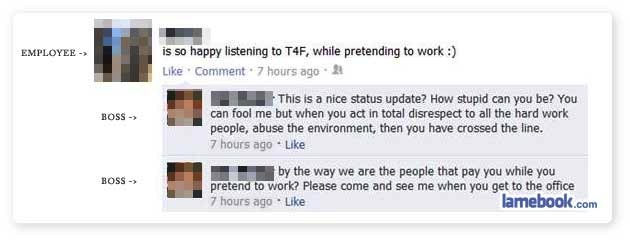
Employees and social media have been a sore spot for employers over the years. Back in the early years of social media, many employers were concerned about the amount of time employees spent in social media during an average work day. Their concerns centered around productivity, rather than what the employees were posting about.

Fast forward to 2020, and we have an entirely new set of problems. During the COVID-19 pandemic, essential worker’s were posting all over social media about their work conditions and at that time lack of PPE. Everyone knows that if you want to get your concerns noticed, turn to social media. It has become one of the most effective ways in which to communicate today on a large scale. If you are lucky, you will be picked up by the news media and your story will become national news.

Social Media and The Whistle Blower

Erin Marie Olszewski is a Nurse-turned-investigative journalist, who has spent the last few months on the frontlines of the coronavirus pandemic, on the inside in two radically different settings. Two hospitals. One private, the other public. One in Florida, the other in New York.

As you can imagine, if you know her story, she has been scrutinized in the media. Some applaud her courage while others try to rip apart her story. So we wondered, who is Erin Olszewski and what does her social media story look like?

We conducted a deep web scan on Erin. Surprisingly, some of her prior “life” was still up for anyone to discover. The deep web scan revealed, as they many times they do, a story of who Erin is and what she has been involved with leading up to her fame.

You can view her entire deep web scan here. (Erin Olszewski) Taking a look at an employee’s online, publicly available, social media content, provides a story board of the person’s life to date. It can reveal a lot about a person, good and bad. In Erin’s case, one is left with the impression that she can be a bit of a rebel rouser. It also shows however, that she is also someone who stands up for what she believes in and isn’t afraid of the consequences.

Can an Employee Get Fired?

This is the new million dollar question. The short answer is, it depends. We did a little research and found the following as a place to start.

  • Some states and localities may have different laws or additional laws.
  • Federal Laws: First Amendment: Free Speech. Doesn’t state that employees or individuals can say whatever they want wherever they want without consequence.
  • According to the National Labor Relations Act: An employee’s comments on social media are generally not protected if they are mere gripes not made in relation to group activity among employees.

NLRA Board Decisions

In the fall of 2012, the Board began to issue decisions in cases involving discipline for social media postings. Board decisions are significant because they establish precedent in novel cases such as these.

*In the first such decision, issued on September 28, 2012, the Board found that the firing of a BMW salesman for photos and comments posted to his Facebook page did not violate federal labor law. The question came down to whether the salesman was fired exclusively for posting photos of an embarrassing accident at an adjacent Land Rover dealership, which did not involve fellow employees, or for posting mocking comments and photos with co-workers about serving hot dogs at a luxury BMW car event. Both sets of photos were posted to Facebook on the same day; a week later, the salesman was fired. The Board agreed with the Administrative Law Judge that the salesman was fired solely for the photos he posted of a Land Rover incident, which was not concerted activity and so was not protected.

*National Labor Relations Act’s website.

In the end, companies of all sizes should have a written social media policy in place. As an added precaution, lawyers have advised social media to be added to any anti- harassment policy as well.

If you are lucky, you will go viral, get picked up by a news outlet, and your story will become national news. Just like what happened with Erin Marie Olszewski.

The COVID-19 Fraud Storm Continues…

When we think of fraud due to the COVID-19 pandemic, we think of individual people committing fraud. After all we are only too familiar with workman’s comp insurance scams & most recently, employee fraud. We have discussed in a previous blog post how one Fortune 500 company had a loss of over $100,000.00 after an employee falsely said they were tested positive for COVID-19.

The story now continues with business fraud. Small businesses across the country have been nearly put out of business due COVID-19. Many have been able to stay afloat from government PPP funding. However, some are sadly starting to take matters into their own hands.

What the Experts Predict

Data analytics provider Verisk has alerted folks that COVID has created opportunities to commit medical billing fraud and abuse. In April, the company said its data reported a 14% increase in claims linked to suspicious billing practices.

Verisk said its Insurance Service Office MedSentry team has identified several COVID-19 medical billing schemes. Among them:

  • Unlisted lab tests. There was no specific ICD-10 code for COVID-19 until April 1. Prior to then any COVID-19 tests were likely coded as “unlisted laboratory tests.” Claims for a patient who has received both an unlisted laboratory test and a COVID-19 test may be cause for scrutiny.
  • Hands-on therapy charges. Many providers eliminated in-office visits and began to offer telehealth sessions. Verisk said bills for hands-on therapies such as chiropractors, physical therapists, and massage therapists should be examined.
  • Unnecessary durable medical equipment. Insurers should be wary of misleading claims for gloves, face masks, thermometers, and similar items, especially for patients who have not been tested for COVID-19 or have tested negative, Verisk said.

Social Media Monitoring

Work is being done to create a software that allows the user to find unapparent connections between all people in a claim to uncover potential scams. While it has a way to go in development, if created, it would be an excellent resource to help investigators identify potential scams and link the culprits.

Google Search – Trending

Google searches can be very revealing and a good indicator of what people are thinking of doing. The question, “How to Burn a Car” has increased 125% since January of this year.

setting car on fire

Not surprising, Google is showing some strong trending in Employment Fraud. The graph below shows Google trends over the last 90 days.

We will continue to report our findings during the pandemic.

Employee Ethics & Fraud During COVID-19

Back in April we wrote about fraud predictions during the COVID 19 pandemic. Back then most of what was out there was PPE (Personal Protective Equipment) fraud. We saw a lot of fakes and it even began to show up in COVID testing. Much of this was controlled by the FDA who provided consumers with updated information on their website on a regular basis.

Once the government released stimulus checks, the scams began. Scammers were contacting people through email, telling them that their check, as part of the stimulus package responding to COVID-19, is already waiting for them and that all they need to do is to provide personal information. This included bank account numbers and Social Security Numbers, which are the key pieces of information needed to perpetrate identity theft.

 Bruce Dorris, J.D, CFE, CPA, President and CEO of the Association of Certified Fraud Examiners, explains that in the current conditions, we can expect to see a number of long-lasting implications. One important one being an explosion of fraud in the coming years — and organizations need to brace themselves.

Corporate Employee Misconduct

Some of our corporate associates have expressed concern with what lies ahead as they navigate the uncertain waters of the Pandemic. One company in particular needed to shut down an entire plant because an employee tested positive for COVID. The employee presented the company with a falsified COVID 19 medical claim. He went as far to provide an excuse letter from a medical facility appearing to corroborate the test results. In concern for its employees and customers, the company closed its facility for cleaning and paid its employees during the shutdown. This caused a loss in excess of $100,000 to the corporation and the unnecessary quarantine of several of the defendant’s coworkers. He is now released on $15,000.00 bail awaiting trial.

FBI Recommendations

The FBI has recommended that companies be particularly alert during the pandemic about possible fraudulent work excuse letters, as they are finding more people attempting to exploit the situation for personal or financial gain.  Submission of a medical claim proven to be false could lead to criminal penalties, including fines or imprisonment by U.S. federal and other authorities.

What This Will Mean for the Private Investigator

Investigation around employee misconduct is an area that could prove to be quite lucrative for investigators. ABC News in Phoenix, AZ did a story on how local investigators are getting calls from corporations to check up on employees who should be working from home. This is not an isolated incident.

I believe we will see more and more fraud cases such as this over the next year if not longer.